




- Women make up 72% of the 104M direct sellers worldwide, showing the industry’s strong role in supporting female entrepreneurship.
- Low startup costs, flexible schedules, and strong community support make direct selling accessible for women balancing work, family, and business.
- QNET supports women entrepreneurs with ethical systems, digital tools, training, and products that help them build sustainable businesses.
Across the globe, more and more women are starting and running businesses, and making meaningful contributions to economic growth in the process. In fact, some reports indicate that women entrepreneurs aren’t just keeping up but are outpacing their male counterparts in innovation.
In this evolving landscape, women in direct selling consistently stand out as powerful examples of how entrepreneurship empowers people from diverse backgrounds to realise their potential and dreams.
Women Have a Strong Participation Across Direct Selling Markets
At its core, direct selling is a retail channel that involves marketing and selling products and services directly to customers outside traditional retail environments. In addition, there’s a second, equally important function in which entrepreneurially-minded people can build their own sales businesses with low start-up costs and overheads.
According to the World Federation of Direct Selling Associations (WFDSA), there are currently 104.3 million direct sellers operating worldwide. And of this number, 72.1% are women.
Women have played a prominent role in the direct selling industry in regions like North America since the 1970s, when the home-based party plan model gained popularity. What’s notable today, however, is that the dominance of women in direct selling isn’t confined to particular regions but cuts across cultures and geographies.
In the Asia Pacific region, for instance, women account for 68% of the 62.3 million direct sellers, with even higher participation in countries such as Kazakhstan (86% of 2.2 million), Japan (82% of 2.2 million), and Thailand (73% of 10.9 million).
A similar pattern can be seen in Latin America (81% of 12.2 million direct sellers), as well as Europe and North America, with 83% of 15.1 million and 75% of 13.3 million, respectively.
But what exactly is behind these figures? And why does direct selling resonate so strongly with women entrepreneurs?
Why Direct Selling Appeals to Women

Women entrepreneurs continue to face numerous obstacles to success, including gender bias and stereotypes, as well as complex administrative and regulatory barriers.
In Africa, Asia-Pacific and Latin America, for instance, millions of women are still excluded from formal financial services. Many also have to deal with limited institutional support, traditional gender roles that restrict business participation, and the burden of unpaid domestic work and caregiving.
Take the case of Indonesia. According to Women’s World Banking, about two-thirds of the country’s 64.2 million MSMEs are women-owned. Yet Indonesian women entrepreneurs often struggle to secure funding, while a lack of networking and mentorship makes it hard to scale and grow.
Where direct selling has made a difference is in responding to these realities and offering a business model that more closely aligns with the circumstances many women face.
Here’s how direct selling continues to be a great avenue for inclusivity and empowerment for women worldwide:
Lower Barriers to Entry
Unlike conventional sales businesses, direct selling doesn’t require offices, retail spaces or large volumes of inventory. This not only eliminates the need for funding but also reduces financial risks — a factor that’s appealing in regions where women receive smaller business loans than men and have less access to credit.
Flexibility
Like other business models, direct selling requires commitment and hard work. And as direct sellers get to choose when, where and how much they work, women entrepreneurs are better able to balance family commitments with running a business. This flexibility is further enhanced by the growing use of innovative digital tools.
Personal Growth
Globally, 133 million girls remain out of school, and women account for nearly two-thirds of the 765 million adults without basic literacy skills. Yet, far from limiting opportunities for growth, direct selling provides a platform for women to develop valuable skills and knowledge through mentorship and structured training programmes.
Supportive Community
While direct sellers are individually responsible for their own performance and earnings, in direct selling, one never truly operates alone. In fact, every entrepreneur is part of a wider network, comprising peers and mentors who provide guidance and encouragement. For many women, this sense of connection and community is as important as earning an income.
QNET and Inclusive Entrepreneurship

This is where direct selling companies come in, as the right approach can spell the difference between short-term gains and genuine empowerment.
That is how QNET, as one of the world’s leading direct selling organisations, continues to play a defining role in providing women with the appropriate structures, systems and safeguards to help them build sustainably thriving businesses.
This can be seen in several concrete ways:
Relevant Products and Services
The company’s portfolio spans wellness and lifestyle, personal development, and travel. All QNET products and services are designed to help women take charge of their lives and livelihoods.

Strong Ethical Foundations
QNET has always prioritised ethical business practices. As such, in addition to incorporating comprehensive policies and procedures, the company has sought to reinforce integrity and professionalism with initiatives such as QNETPRO.
Convenient and Innovative Digital Systems
Complex processes can pose a hurdle to growth, which is why QNET focuses on leveraging technology and utilising convenient centralised e-commerce systems for signing up as direct sellers, making purchases and sales, and delivering products and services.
Training, Mentorship, and Community
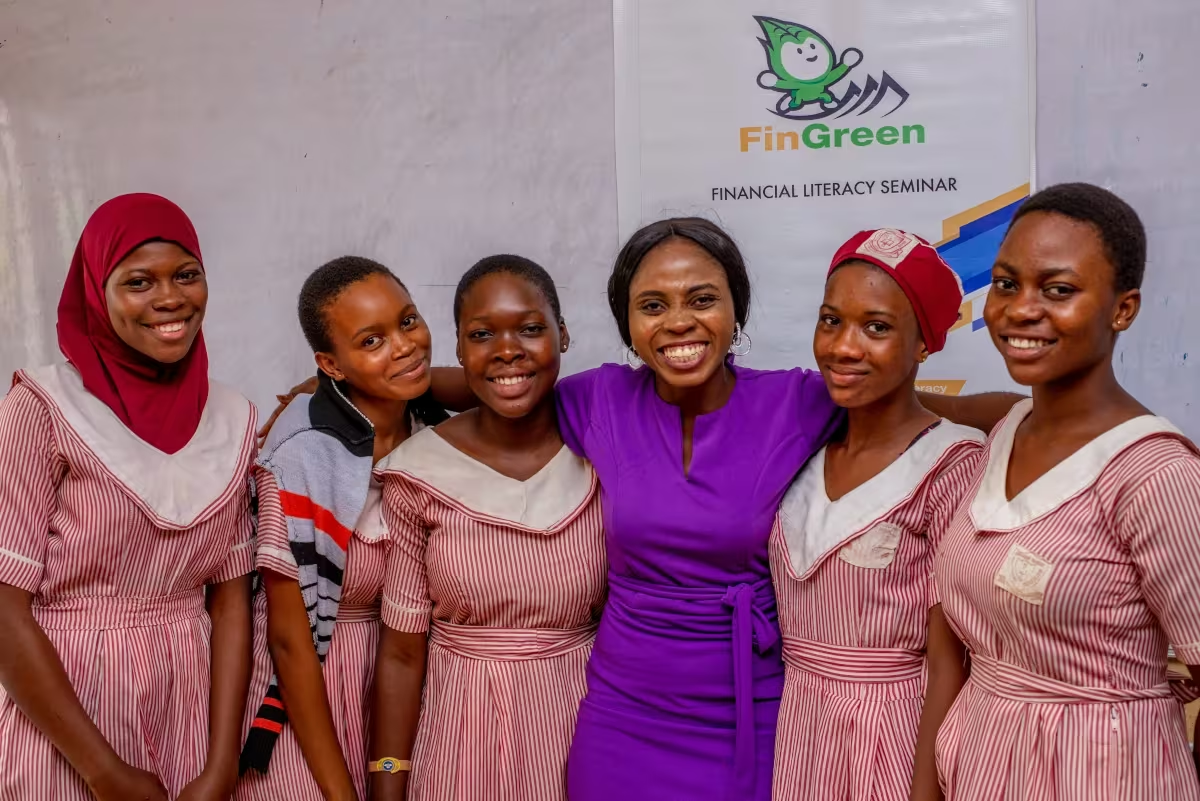
QNET direct sellers are part of a global network of distributors across over 100 countries, which ensures constant guidance and connection. The company also emphasises development and training through programmes such as FinGreen.
Recognition and Sustainable Earnings
In addition to a structured compensation and rewards plan, QNET also emphasises recognition through initiatives such as the QNET Achievers’ Club, aiming to encourage consistency, progression, and long-term success.
Women Empowerment in Action
At the end of the day, it’s clear: direct selling is more than just a sales approach or a means of earning; it is a meaningful pathway for women to participate in the economy on their own terms.
Yes, women continue to face a range of complexities and challenges. However, when supported by responsible companies, inclusive systems and structures, and ethical frameworks, direct selling can serve as a platform for long-term success.
Most importantly, far from a passing fad, the continued rise of women in direct selling demonstrates what entrepreneurship can look like when industries focus on opportunity and empowerment.










I really love V Partner Sharfun Shaikh